Name(Required)
Untitled(Required)

Our Stories | Avincis supports major aerial firefighting operation during Los Gallardos wildfire in Almería

As wildfires continue to pose an increasing threat across southern Europe, Avincis crews played a key role in supporting the response to the recent Los Gallardos wildfire in Almería, working alongside INFOCA, the Unidad Militar de Emergencias (UME) and other emergency services to help protect communities and contain one of the region’s most significant fires this summer.

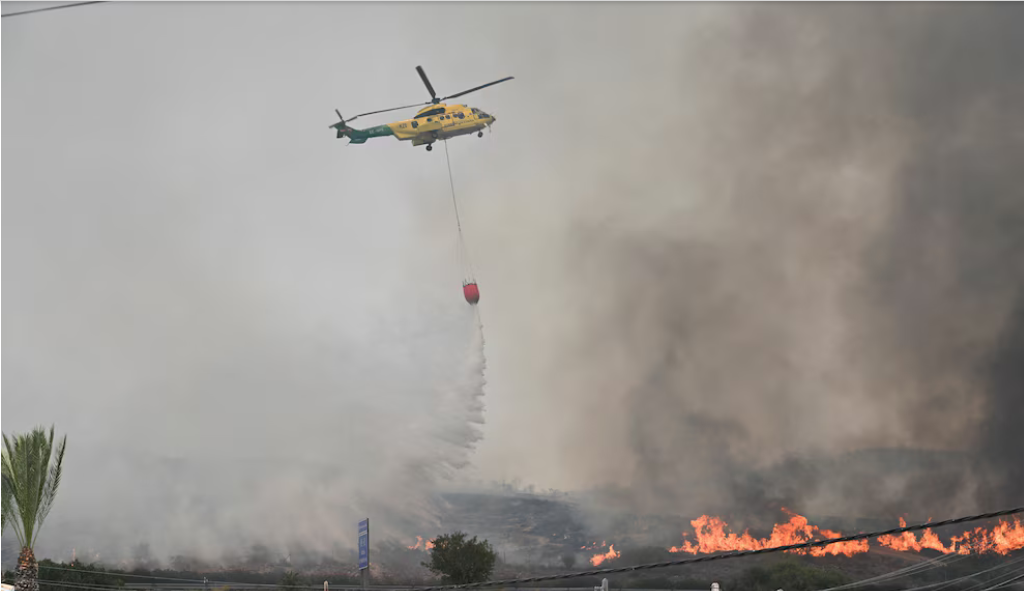
Operating in challenging conditions, Avincis helicopters provided sustained aerial support throughout the operation, transporting specialist forest firefighters into difficult terrain while delivering continuous water and foam drops to slow the fire’s advance and assist ground crews.

In a unique aspect of the mission, two Avincis Helicopter Emergency Medical Services (HEMS) helicopters were also activated to evacuate people from affected areas, highlighting the versatility of the company’s emergency aviation capabilities. Across the mission, Avincis helicopters transported 124 forest firefighters, completed 596 water drops, delivering more than 1.24 million litres of water, and carried out 117 foam drops, deploying almost 165,000 litres of foam.

The operation demonstrated the critical role that aerial firefighting plays in supporting emergency services during fast-moving wildfires. Helicopter crews worked in demanding conditions, conducting repeated water collection cycles while maintaining precision flying over active fire fronts. Every drop required close coordination between pilots, crews and firefighters on the ground to maximise effectiveness and help protect lives, property and the natural environment.

One of the most challenging aspects of aerial firefighting is operating in environments where visibility, heat and rapidly changing fire behaviour can significantly affect flight conditions. During water collection, mineral deposits from the water can quickly build up on helicopter windscreens, requiring continuous use of the windscreen wipers to maintain pilots’ visibility and ensure safe operations throughout each mission.

Captain Pedro Fernandez Vicente said: “I’ve been working as a helicopter pilot fighting forest fires for 30 years now, and I’ve been to many fires in Spain, Portugal and Chile. In the Los Gallardos fire, the only thing that stood out to me was the rapid spread of the fire.

“Fighting forest fires is always difficult and especially demanding for helicopters and crews. Fires always occur in extreme conditions: high temperatures, low humidity, challenging terrain and high altitude in the mountains – a perfect recipe for disaster. Our work in fighting fires is crucial, and we are the perfect complement and support for ground firefighting efforts, combining personnel on the ground with water and foam from the air. It’s a job that either fascinates you or repels you; there’s no room for doubt or lack of preparation.”

The Los Gallardos wildfire highlighted the importance of integrated emergency response. Working alongside INFOCA, UME and other emergency services, Avincis crews formed part of a coordinated aerial and ground operation that helped protect communities threatened by the fire, including the village of El Marchal, where emergency responders worked tirelessly to prevent homes from being lost as flames surrounded the area overnight.

As wildfire seasons become longer and more severe across Europe, the need for highly trained crews, specialised aircraft and year-round preparedness continues to grow. Avincis remains committed to supporting governments and emergency services with the expertise, operational experience and aviation capability needed to respond rapidly when communities are under threat.

Every wildfire response reinforces the importance of preparation, partnership and professionalism. The dedication shown by Avincis crews and all emergency responders throughout the Los Gallardos operation reflects the shared commitment to protecting lives, landscapes and communities when they need it most.

See our crew in action on our YouTube channel

As wildfires continue to pose an increasing threat across southern Europe, Avincis crews played a key role in supporting the response to the recent Los Gallardos wildfire in Almería, working alongside INFOCA, the Unidad Militar de Emergencias (UME) and other emergency services to help protect communities and contain one of the region’s most significant fires this summer.

Operating in challenging conditions, Avincis helicopters provided sustained aerial support throughout the operation, transporting specialist forest firefighters into difficult terrain while delivering continuous water and foam drops to slow the fire’s advance and assist ground crews.

In a unique aspect of the mission, two Avincis Helicopter Emergency Medical Services (HEMS) helicopters were also activated to evacuate people from affected areas, highlighting the versatility of the company’s emergency aviation capabilities. Across the mission, Avincis helicopters transported 124 forest firefighters, completed 596 water drops, delivering more than 1.24 million litres of water, and carried out 117 foam drops, deploying almost 165,000 litres of foam.

The operation demonstrated the critical role that aerial firefighting plays in supporting emergency services during fast-moving wildfires. Helicopter crews worked in demanding conditions, conducting repeated water collection cycles while maintaining precision flying over active fire fronts. Every drop required close coordination between pilots, crews and firefighters on the ground to maximise effectiveness and help protect lives, property and the natural environment.

One of the most challenging aspects of aerial firefighting is operating in environments where visibility, heat and rapidly changing fire behaviour can significantly affect flight conditions. During water collection, mineral deposits from the water can quickly build up on helicopter windscreens, requiring continuous use of the windscreen wipers to maintain pilots’ visibility and ensure safe operations throughout each mission.

Captain Pedro Fernandez Vicente said: “I’ve been working as a helicopter pilot fighting forest fires for 30 years now, and I’ve been to many fires in Spain, Portugal and Chile. In the Los Gallardos fire, the only thing that stood out to me was the rapid spread of the fire.

“Fighting forest fires is always difficult and especially demanding for helicopters and crews. Fires always occur in extreme conditions: high temperatures, low humidity, challenging terrain and high altitude in the mountains – a perfect recipe for disaster. Our work in fighting fires is crucial, and we are the perfect complement and support for ground firefighting efforts, combining personnel on the ground with water and foam from the air. It’s a job that either fascinates you or repels you; there’s no room for doubt or lack of preparation.”

The Los Gallardos wildfire highlighted the importance of integrated emergency response. Working alongside INFOCA, UME and other emergency services, Avincis crews formed part of a coordinated aerial and ground operation that helped protect communities threatened by the fire, including the village of El Marchal, where emergency responders worked tirelessly to prevent homes from being lost as flames surrounded the area overnight.

As wildfire seasons become longer and more severe across Europe, the need for highly trained crews, specialised aircraft and year-round preparedness continues to grow. Avincis remains committed to supporting governments and emergency services with the expertise, operational experience and aviation capability needed to respond rapidly when communities are under threat.

Every wildfire response reinforces the importance of preparation, partnership and professionalism. The dedication shown by Avincis crews and all emergency responders throughout the Los Gallardos operation reflects the shared commitment to protecting lives, landscapes and communities when they need it most.

See our crew in action on our YouTube channel