




 da
da  es
es  fi
fi  it
it  nb
nb  pt
pt  sv
sv 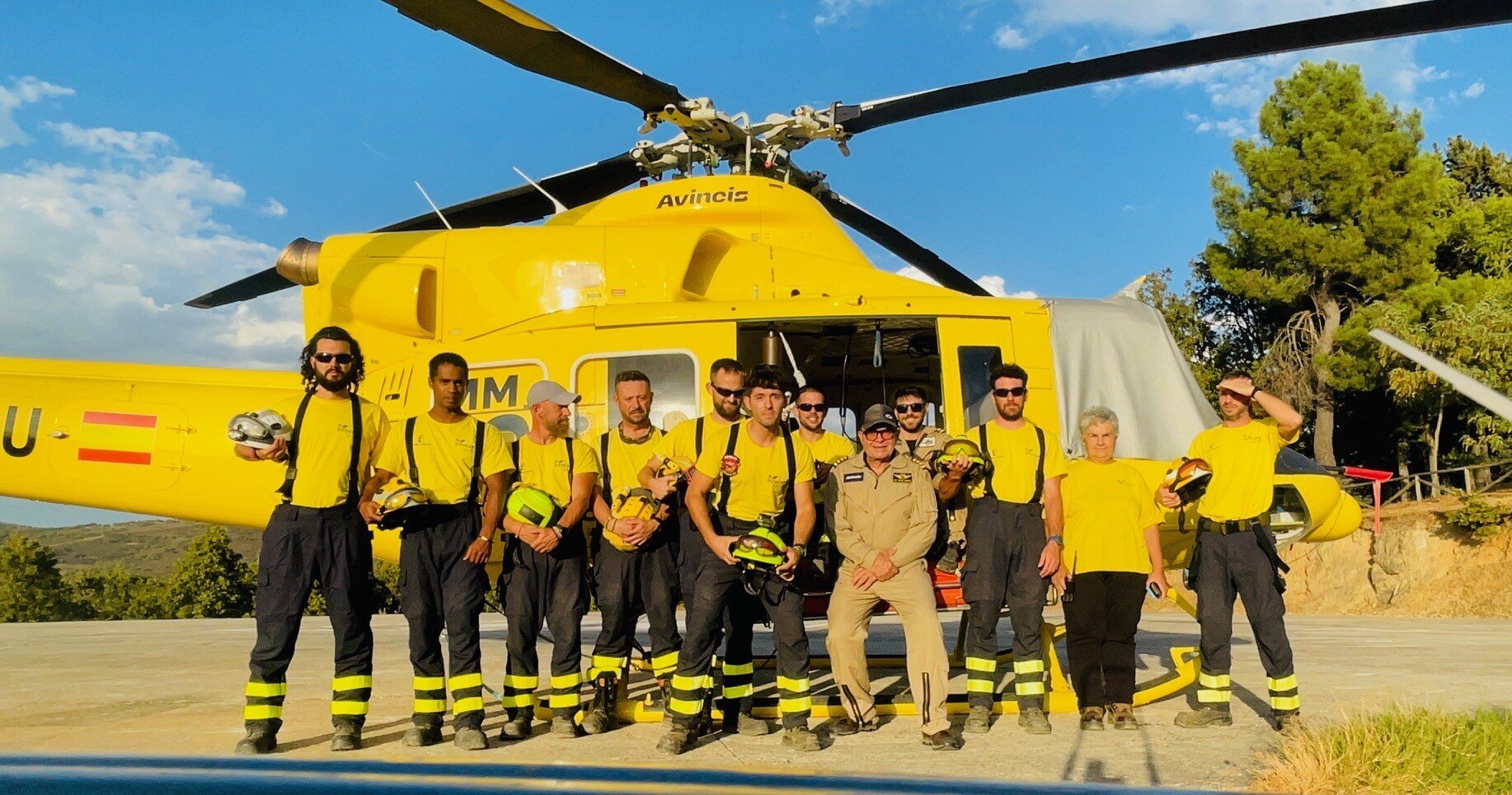
Our Stories | In the heart of the flames: The Avincis teamwork behind a critical extraction
Share


During the Peñalba de la Sierra wildfire — a small mountain hamlet in central Spain’s Guadalajara province — two Bell 412 helicopters operated by Avincis for the Gobierno de Castilla-La Mancha executed one of the most complex extractions of the firefighting season.
Sixteen firefighters from the BRIF Lubia were trapped on a steep ridge, exposed to smoke inhalation and burns. Their safe evacuation was made possible through the precision, experience, and calm decision-making of the Avincis crews.
Courage under pressure
Captain Miguel Gnecco, flying from the Corduente base, recalls the moment the mission became critical: “After several hours of water drops, we received an urgent alert to rescue the Lubia brigade. They were trapped on a cliff, some suffering smoke inhalation and burns, and their exact location was unclear due to dense smoke and strong winds.”
With ground access impossible, Gnecco relied on altitude, visual cues, and extensive planning to locate the firefighters. Carefully assessing obstacles, wind direction, and landing options, he guided his CoPilot Andrea Celletti step by step through the approach.
“You have to stay calm and have a plan B,” he said. “The smoke, the wind, the terrain — every variable matters. Our training and years of experience meant we could make fast, safe decisions.”

Captain Miguel Gnecco, CoPilot Andrea Celletti and the firefighters they saved.
Meanwhile, Captain Carlos Valencia, flying from Robledo de Buey, had been supporting firefighting operations in the northern valley. As the fire intensified, he realised the Lubia brigade faced immediate danger. “We saw that the firefighters were in a very high, rocky area with almost no margin for error,” Valencia explained. “With the Bambi bucket deployed, entering directly would have fanned the flames or pushed smoke towards the firefighters. I made the decision to drop it first, then return for the evacuation.”
Precision, coordination, and teamwork
Both helicopters worked in close coordination under challenging conditions. Gnecco landed on a narrow, smoke-filled ledge, guiding the firefighters into the helicopter, while Valencia positioned his aircraft to retrieve the remaining personnel safely.
CoPilot Christopher Boecker, assisting Valencia alongside base technician Víctor Rodríguez, highlighted the importance of clear communication and shared procedures: “Carlos and I have flown countless fires together, and that experience helped us maintain focus and make split-second decisions. The brigade remained calm and professional, which made all the difference.”
Every second was critical. Dense smoke, unpredictable winds, and steep terrain left no margin for error. Yet, through calm leadership, teamwork, and adherence to rigorous training, all 16 firefighters were safely evacuated.
Reflections on the mission
The pilots emphasised the importance of preparation, experience, and ongoing training. “We train these scenarios at the start of every season,” Valencia noted. “Standardising procedures and practising emergency decision-making ensures that when the moment comes, we act as one team.”
Gnecco reflected on the personal impact: “Every day you learn something new, no matter how long you’ve been flying. What motivates me most is knowing that our work helps people get home to their families safely.”
This mission underlines the essential role of helicopters in wildfire response, particularly in remote, rugged terrain, and highlights the skill, professionalism, and teamwork that define Avincis crews.

Captain Carlos Valencia, base technician Víctor Rodríguez, and CoPilot Christopher Boecker.
"Standardising procedures and practising emergency decision-making ensures that when the moment comes, we act as one team."
"Standardising procedures and practising emergency decision-making ensures that when the moment comes, we act as one team."
Share